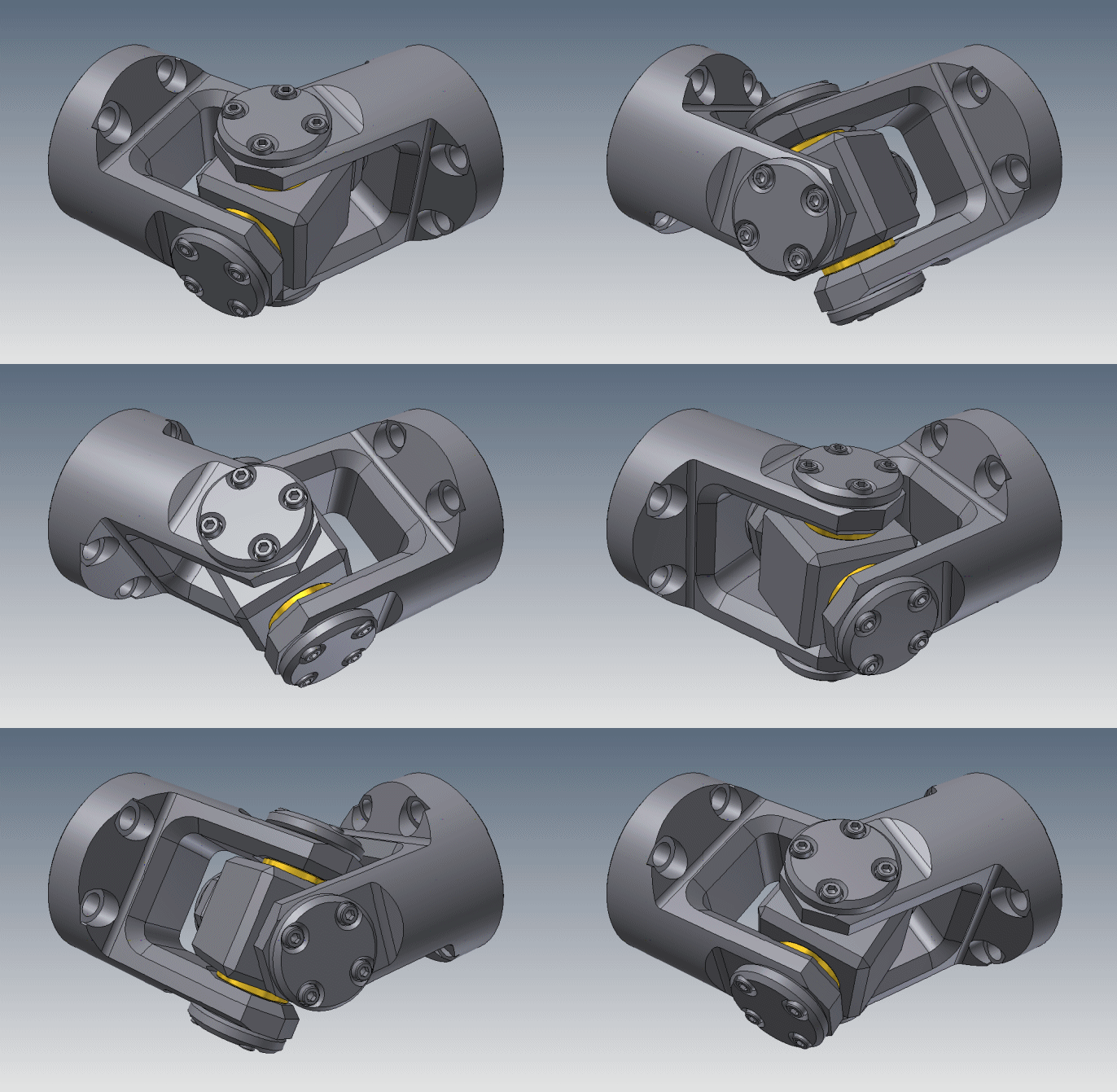
Mechanical Design & Manufacturing using SolidWorks
Description
Students develop the skills required to design real mechanical parts, mechanisms, and complete machines using SolidWorks.
They learn how to analyze a mechanical part, create accurate and fully defined sketches, select the appropriate modeling features, and build professional parametric 3D models with strong Design Intent.
Alongside CAD skills, students explore essential machine components including Shafts, Bearings, Fasteners, Couplings, Pulleys, Belts, and Gears, understanding how these components work together to transmit motion and power inside real machines.
Students progress from individual parts to mechanisms, subassemblies, and complete machine assemblies while learning Engineering Drawing, Tolerances, Materials, Design for Manufacturing, Motion, Fits, and Assembly Design.
By the end of the course, students move beyond simply using SolidWorks tools to thinking as mechanical designers: analyzing requirements, selecting components, designing manufacturable parts, and integrating them into a complete functional machine.
Learning Objectives
By the end of the course, students will be able to:
- Understand the basic Mechanical Engineering Design Process.
- Read and interpret basic Engineering Drawings.
- Understand dimensions, measurement, tolerances, clearances, and fits.
- Analyze the geometry of a mechanical part before modeling it.
- Select the appropriate starting plane and modeling strategy for a part.
- Create accurate and Fully Defined Sketches.
- Apply geometric relations and dimensions correctly.
- Understand Parametric Modeling and Design Intent.
- Select the appropriate SolidWorks feature based on part geometry.
- Use Extrude, Cut, Revolve, Sweep, Loft, Shell, Rib, Pattern, Mirror, Fillet, Chamfer, and Hole features.
- Plan and organize a logical Feature Tree for mechanical parts.
- Design increasingly complex mechanical parts from engineering requirements.
- Measure and reverse-engineer simple physical components.
- Understand common engineering materials and their applications.
- Understand the fundamentals of 3D Printing, CNC Machining, and Laser Cutting.
- Design parts while considering real manufacturing limitations.
- Understand and design with Fasteners, Shafts, Bearings, Bushings, and Couplings.
- Understand Gears, Pulleys, Belts, and mechanical power transmission.
- Understand basic relationships between Speed, Torque, and Transmission Ratio.
- Design simple mechanisms for transmitting and converting motion.
- Select suitable mechanical components for a machine.
- Design motor mounts, bearing supports, shafts, frames, and other functional machine parts.
- Create mechanical Subassemblies and Complete Assemblies.
- Apply SolidWorks Mates and understand Degrees of Freedom.
- Analyze mechanical motion inside an assembly.
- Detect interference, clearance, and assembly problems.
- Modify parts based on assembly and manufacturing requirements.
- Create Engineering Drawings, Exploded Views, and Bills of Materials.
- Break a complete machine into Systems, Subsystems, Components, and Parts.
- Transform engineering requirements into a complete mechanical design.
- Integrate individually designed parts and standard components into a functional machine assembly.
- Complete the engineering workflow from Requirements → Concept → Part Design → Component Selection → Assembly → Verification → Manufacturing Documentation.