Reach new heights
Start learning today!
Skill up and have an impact! Your business career starts here.
Time to start a course.
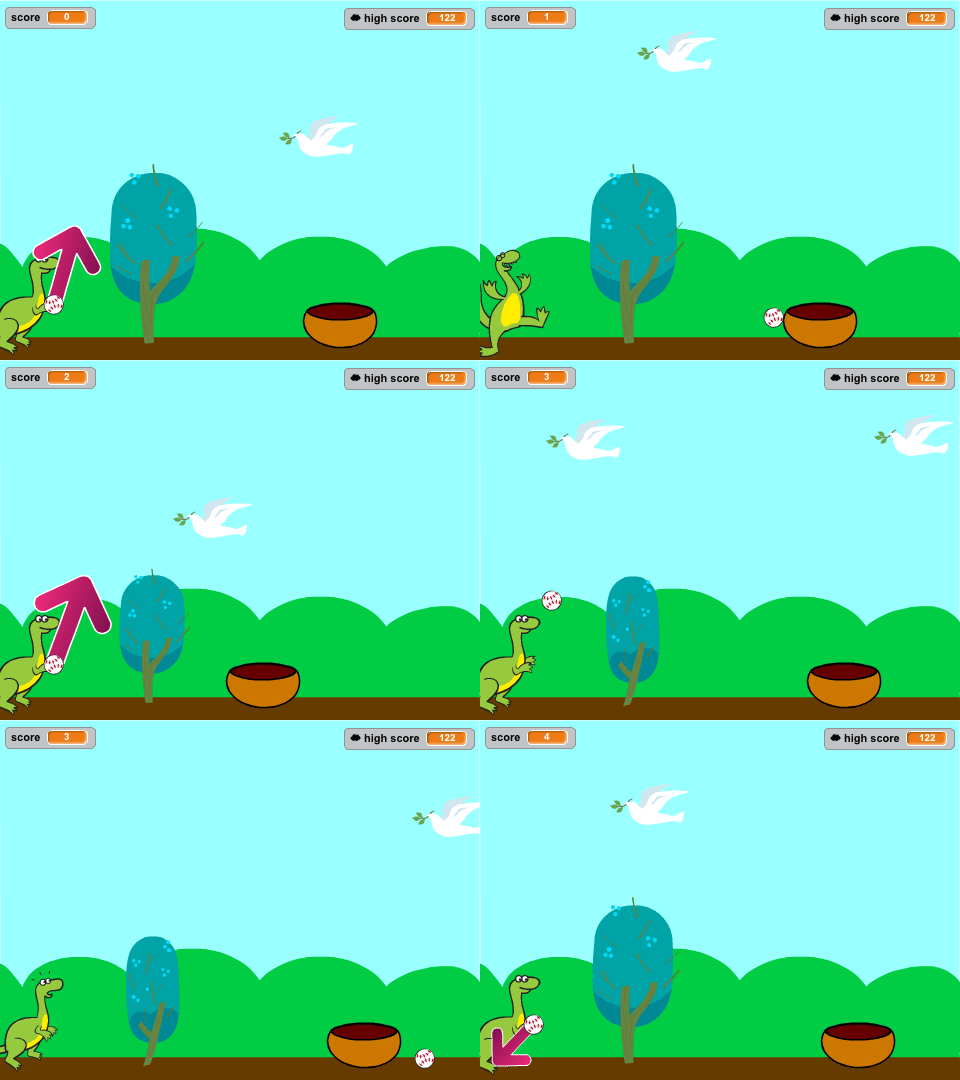
Through this course, kids learn essential programming concepts such as sequencing, loops, conditionals, arithmetical operations, logical operations and variables. They develop computational thinking skills as they break down problems into smaller steps, plan the execution of actions, and control the behavior of their programs.
Description
Students now bring programming, electronics, sensing, motion, and mechanical construction together to enter the world of Robotics.
Instead of simply operating ready-made robots, students learn how robots are built from the inside out.
They explore every major part of a robotic system, including the Controller, Motor Drivers, Motors, Sensors, Power System, electronic connections, and mechanical structure.
Students build their robots step by step and wire the electronic systems themselves, developing a deeper understanding of how software decisions become physical movement.
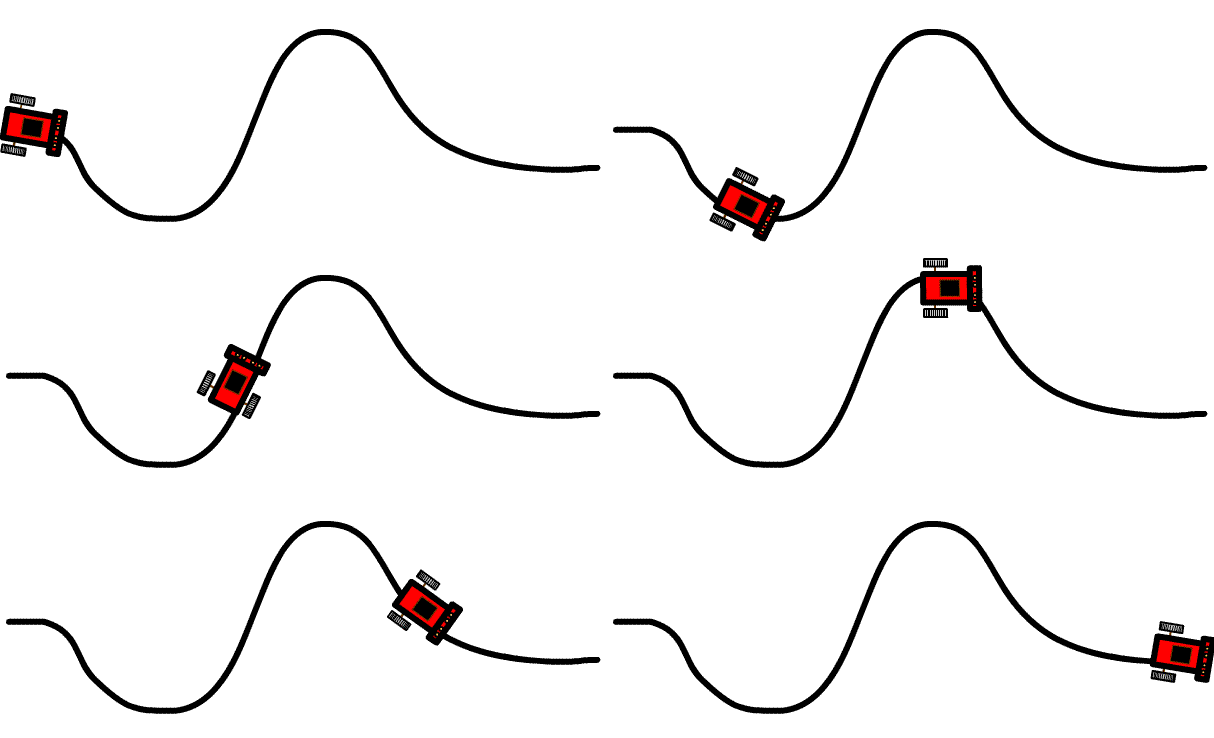
Through increasingly challenging robots, students explore Robot Motion, Navigation, Path Planning, Obstacle Avoidance, Line Following, Remote Control, and Autonomous Behavior.
Learning Objectives
By the end of the course, students will be able to:
- Understand the basic architecture of a robotic system.
- Identify the Controller, Sensors, Actuators, Power System, and Mechanical Structure of a robot.
- Understand how electronics, programming, and mechanics interact inside a robot.
- Build and wire a complete mobile robot.
- Connect Arduino to Motor Drivers and DC Motors.
- Control robot movement and direction.
- Program Forward, Backward, Left, Right, and Stop movements.
- Understand basic Differential Drive behavior.
- Control robot speed and direction.
- Understand the concept of Robot Navigation.
- Plan simple movement paths.
- Develop a Path Planning Robot.
- Use Sensors to detect obstacles.
- Program autonomous Obstacle Avoidance behavior.
- Understand basic Line Detection.
- Build and tune a Line Follower Robot.
- Remotely control a robot through a Mobile Application.
- Compare Manual, Remote-Controlled, and Autonomous Robots.
- Design robots for specific tasks.
- Build a Forklift Robot.
- Build a Cleaner Robot.
- Test and troubleshoot complete robotic systems.
- Improve robot behavior through experimentation and iteration.
- Understand the basic autonomous loop of Sense → Decide → Move → Re-evaluate.
- Integrate Programming + Electronics + Sensors + Motion + Mechanics into one robotic system.
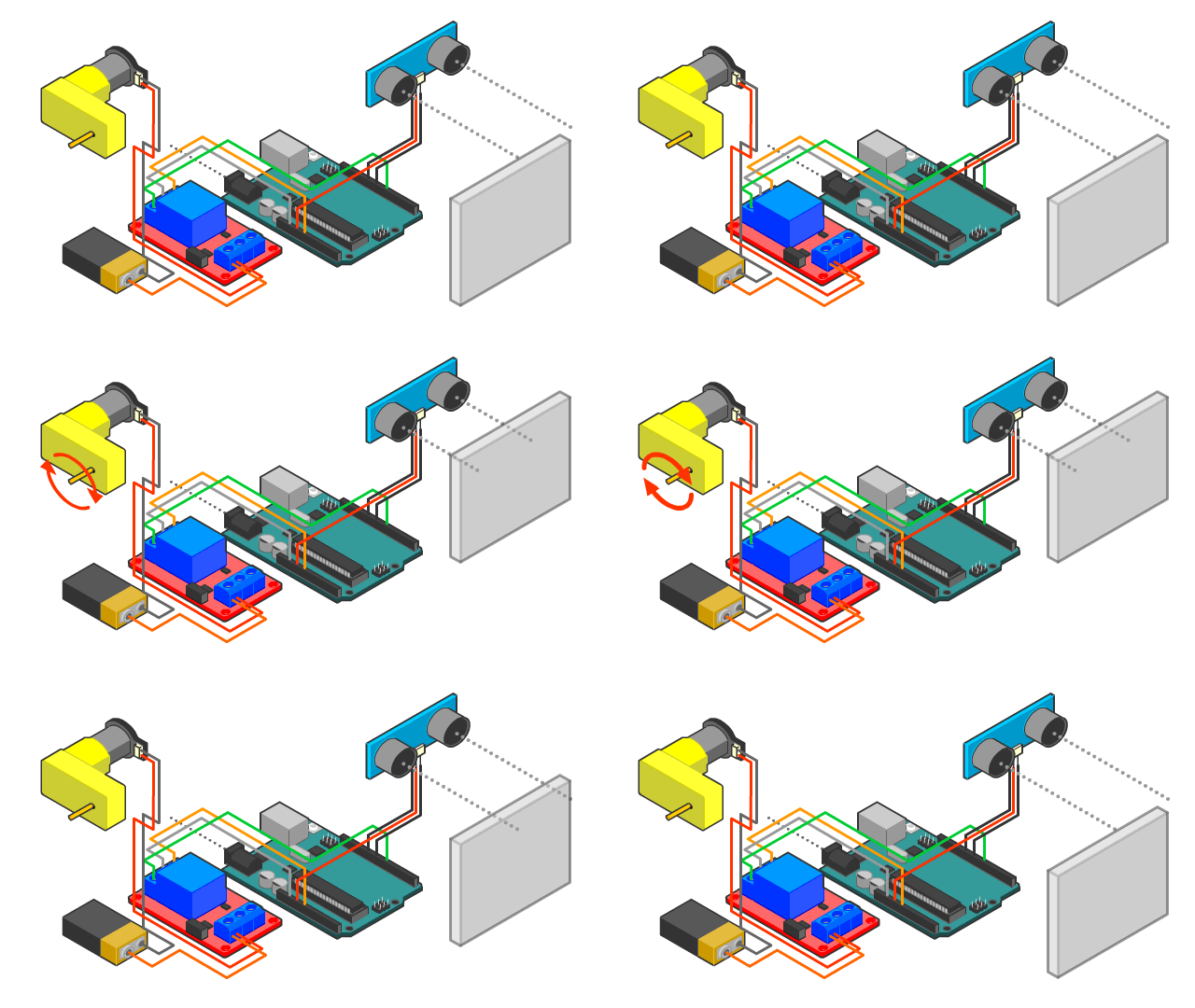
In this course, They learn to write code that controls electronic components like sensors, and Actuators. This allows them to translate the voltage signals to code responding to the inputs, display information, and control movement which makes them able to design and create the following Projects:
- Irrigation System Project
- Lightening System Project
- Laser security system project
- Fish Feeder
- Radar Project
- Smart Dustbin Project
- Smart Water Dispenser Project
- Smart Train Gate Project
Description
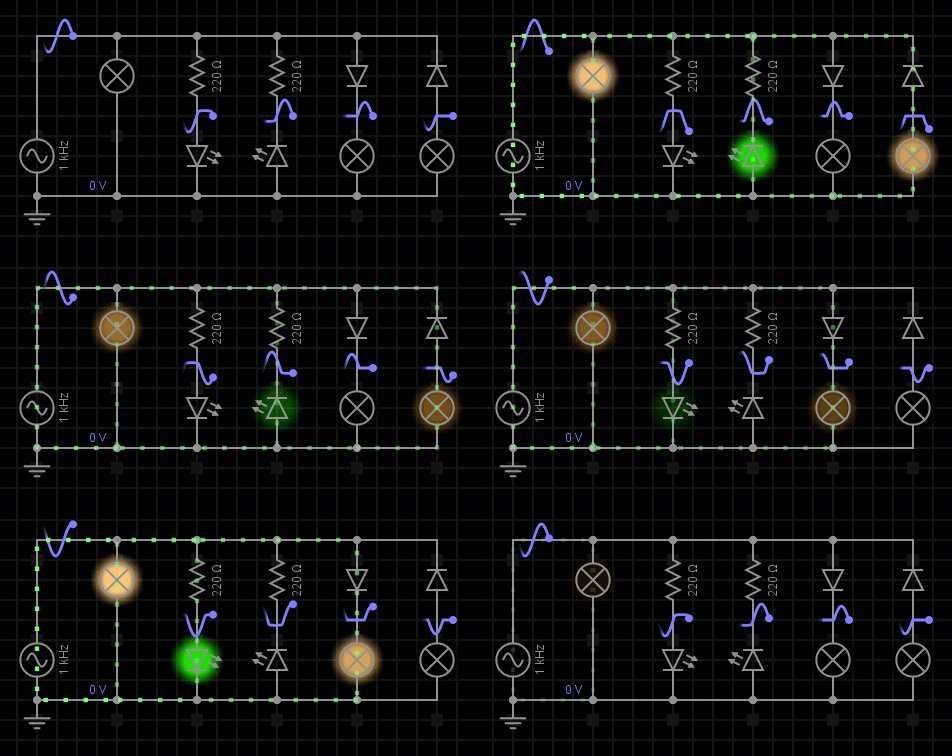
Students build a strong foundation in Electrical and Electronics Engineering, progressing from fundamental DC electrical principles to the design and manufacturing of complete electronic circuits and printed circuit boards.
Students begin by understanding and calculating Voltage, Current, Resistance, Power, and Energy, then analyze Series and Parallel circuits using Ohm's Law and Kirchhoff's Laws.
They investigate electronic components including Resistors, Capacitors, Diodes, Transistors, MOSFETs, Voltage Regulators, and Operational Amplifiers, learning not only how each component works but also how engineers select and calculate appropriate component values.
Students then progress to practical engineering circuits including Power Supplies, Voltage Regulation, Filtering, Protection, Switching, Motor Driving, Signal Conditioning, and Amplification.
Finally, students transform their circuits into professional Single-Layer and Double-Layer PCBs, learning schematic design, PCB layout, routing, grounding, manufacturing files, soldering, testing, and PCB fabrication using processes including CNC PCB Manufacturing.
By the end of the course, students move from assembling circuits to designing, calculating, manufacturing, testing, and troubleshooting their own electronic systems.
Learning Objectives
By the end of the course, students will be able to:
- Understand Voltage, Current, Resistance, Power, and Energy in DC electrical systems.
- Apply Ohm's Law to analyze and design electrical circuits.
- Analyze Series and Parallel circuits.
- Apply Kirchhoff's Voltage Law and Kirchhoff's Current Law.
- Calculate voltage, current, resistance, and power requirements.
- Select appropriate component values and power ratings.
- Use a Digital Multimeter to measure Voltage, Current, Resistance, and Continuity.
- Understand the behavior and applications of Resistors and Capacitors.
- Understand RC charging, discharging, filtering, and timing.
- Understand semiconductor fundamentals.
- Use Diodes, LEDs, Zener Diodes, and Rectifier Diodes correctly.
- Understand BJT Transistors and MOSFETs.
- Design transistor-based switching and load-driving circuits.
- Understand basic amplification.
- Design basic DC Power Supply and Voltage Regulation circuits.
- Understand Linear Regulators, LDOs, Buck and Boost Converter concepts.
- Design basic electronic Protection Circuits.
- Understand the fundamentals of Operational Amplifiers.
- Build Comparator, Buffer, Amplifier, and Signal Conditioning circuits.
- Read and create electronic schematics.
- Analyze electronic systems as functional circuit blocks.
- Prototype circuits and verify their operation using measurements.
- Troubleshoot common electronic circuit problems.
- Design Single-Layer PCBs.
- Design Double-Layer PCBs using Vias and Copper Planes.
- Understand PCB design rules, track widths, clearances, grounding, and component placement.
- Generate Gerber, Drill, and manufacturing files.
- Understand PCB manufacturing workflows.
- Manufacture PCBs using CNC PCB manufacturing equipment.
- Assemble and solder Through-Hole and SMD components.
- Test manufactured PCBs before and after power-up.
- Complete an electronic product from Requirements → Calculations → Circuit → PCB → Manufacturing → Testing.

Description
This course represents one of the main goals of the ExpoTec journey: moving students from machines that simply follow programmed instructions to machines capable of understanding information from their environment.
Students begin by understanding how computers represent and process digital images.
Using Python and OpenCV, they learn how to capture images and video from cameras, manipulate images, extract useful information, identify shapes and colors, track objects, and detect visual features.
They then progress into more advanced Computer Vision applications and are introduced to AI-based visual recognition and detection.
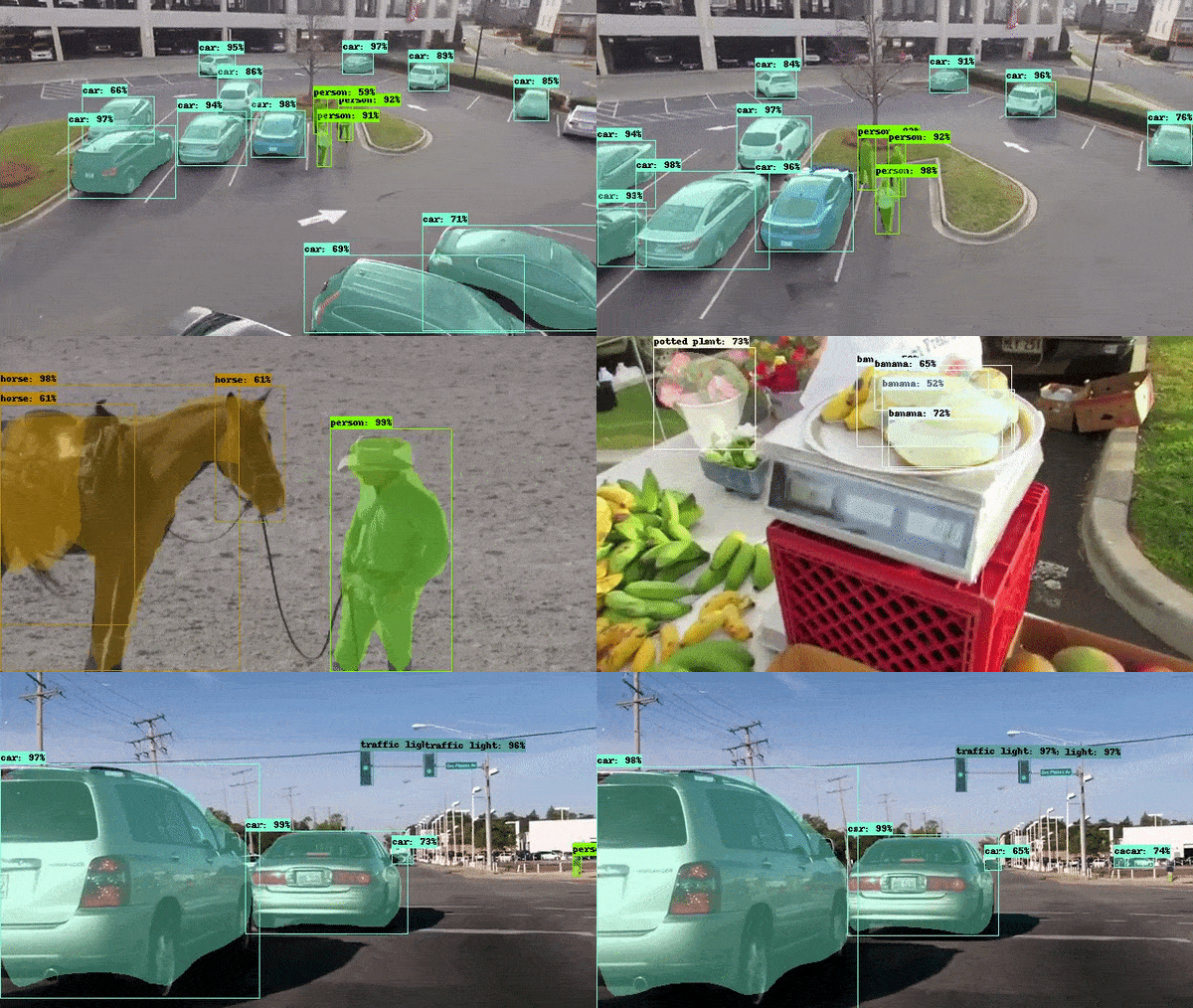
Students use pre-trained AI models and appropriate libraries to enable their Raspberry Pi systems to recognize and detect objects from camera input.
Most importantly, students connect Computer Vision back to the physical engineering systems they have built throughout ExpoTec.
A camera is no longer simply used to display video.
It becomes a sensor capable of providing rich information to a machine.
The system can:
See → Process → Understand → Decide → Act
This allows students to begin developing intelligent robots and machines that react to visual information from the real world.
Learning Objectives
By the end of the course, students will be able to:
- Understand how digital images are represented by computers.
- Understand Pixels, Resolution, and Color Channels.
- Capture images and video using cameras.
- Use OpenCV with Python.
- Read, display, resize, crop, and transform images.
- Work with RGB, Grayscale, and other image representations.
- Apply basic Image Filtering.
- Understand Thresholding.
- Detect basic shapes and visual features.
- Perform Color Detection.
- Understand Contours.
- Track objects through video.
- Process real-time camera streams.
- Understand the difference between traditional Image Processing and AI-based Computer Vision.
- Understand the basic concept of Machine Learning.
- Understand the basic concept of Neural Networks at an introductory level.
- Use Pre-Trained AI Models.
- Perform basic Object Detection.
- Process detection results programmatically.
- Connect visual detection results to physical machine behavior.
- Build Raspberry Pi-based Computer Vision applications.
- Integrate Cameras + Python + AI + Electronics + Robotics into intelligent systems.
Description:
Students discover how programming transforms electronic hardware into an interactive product by designing and building their own DIY mobile phone inspired by classic mobile phones.
Using a microcontroller, display, keypad, and other electronic components, students first build the hardware architecture of the device and then focus heavily on developing its software.
They create menus, icons, screens, navigation systems, applications, and games while learning how different software components work together inside a single electronic product.
Instead of seeing software as individual programs, students begin understanding it as an organized system that manages user input, application behavior, graphical interfaces, and hardware.
The course gives students the experience of working like early mobile-device engineers: building both the electronic device and the software that gives it its functionality and identity.
Learning Objectives
By the end of the course, students will be able to:
- Understand the basic architecture of a handheld electronic device.
- Integrate a microcontroller, display, keypad, and other electronic components.
- Read and process multiple user inputs from a keypad.
- Display text, graphics, symbols, and icons on a screen.
- Understand the concept of a User Interface (UI).
- Design menu-based interfaces.
- Build navigation between different screens.
- Organize software into different functions and modules.
- Understand application states and screen states.
- Handle user input according to the current application state.
- Develop multiple applications within one device.
- Create interactive software rather than simple sequential programs.
- Build basic graphical games.
- Develop a Snake-style game.
- Combine hardware interaction and software interfaces.
- Debug increasingly complex software.
- Understand how software determines the functionality of an electronic product.
- Build a complete software-driven electronic product.