Skip to Content

All Courses

Junior Coding
Junior Coding

Learn programming tools and fundamentals to be able to write codes for future STEM projects

Level 1 Junior STARtec
Electronics Projects using Pictoblox

Description:

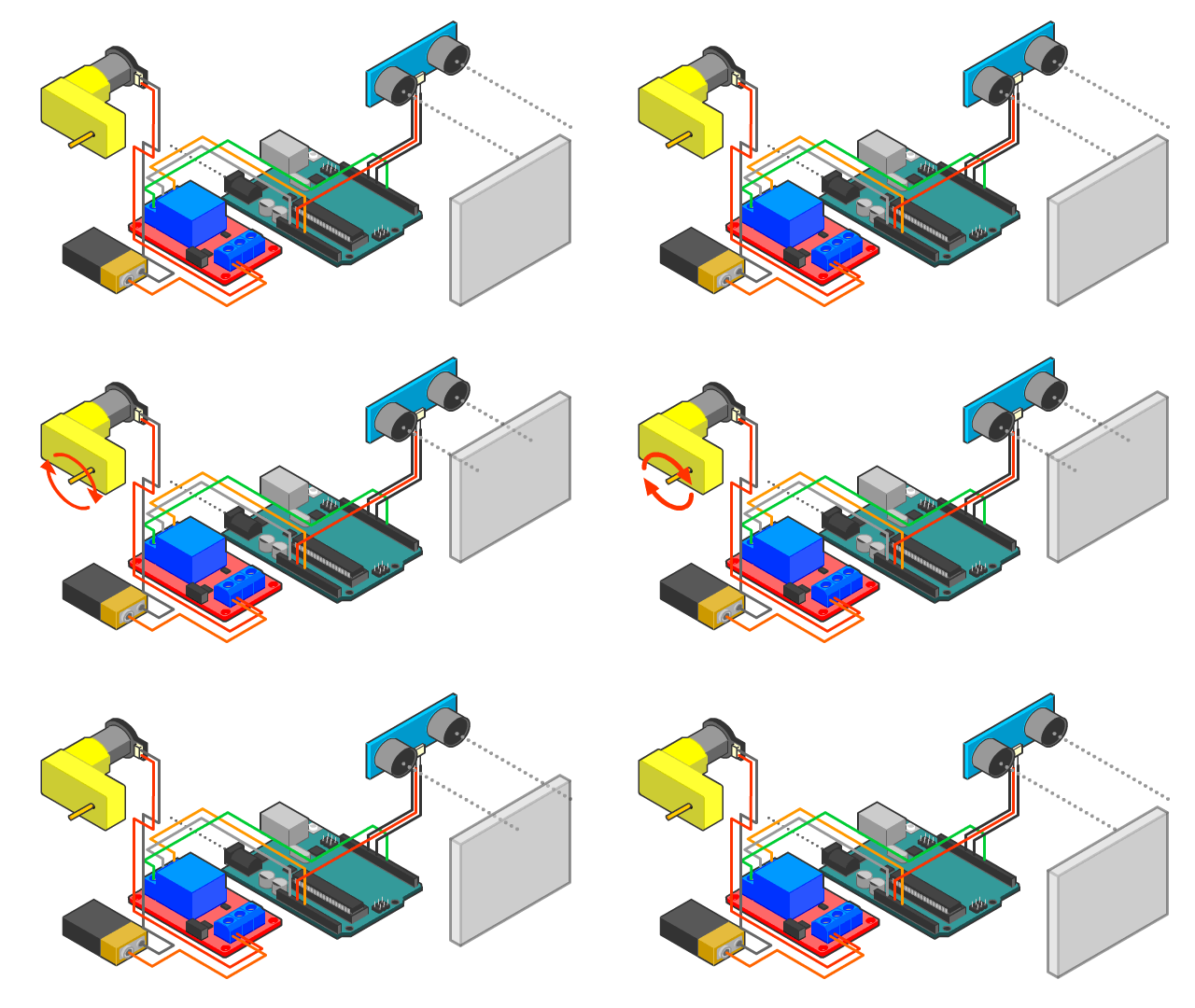
Students are introduced to Arduino as the “brain” of a smart system.

Instead of controlling projects manually, students discover how sensors allow machines to understand their surroundings and how simple programs allow the system to decide what action to take.

Many projects intentionally revisit ideas from Electronics Projects and transform them from manual systems into intelligent automated systems.

Learning Objectives

By the end of the course, students will be able to:

  • Understand Arduino as a programmable controller.
  • Understand the relationship between Input → Processing → Output.
  • Write and modify simple Arduino programs.
  • Control LEDs, buzzers, motors, and servos using code.
  • Understand digital inputs and outputs at an introductory level.
  • Read information from simple sensors.
  • Understand the purpose of different sensors.
  • Use conditions to make simple decisions.
  • Understand the concept of If this happens → Do that.
  • Replace manual controls with sensor-based automatic control.
  • Combine a sensor, Arduino, and actuator into a complete system.
  • Observe sensor readings and relate them to the physical world.
  • Troubleshoot basic Arduino projects.
  • Explain why a smart system behaves in a particular way.
Level 1 Junior STARtec
Junior Robot
Junior Robot

Build, Code, and Innovate with Sensor-Based Robots, Mastering Real-World Problem-Solving like front collision avoidance system.  

Level 1 Junior STARtec
Advanced STEM Projects

These projects for kids are introducing them to advanced robotics and control systems: 

  • Voice-Controlled Actuators: Kids use voice commands to control motors or LEDs, learning automation.
  • Bluetooth-Controlled Robot: A mobile app controls a 4-wheeled robot via Bluetooth, teaching wireless communication.
  • Lifter and Gripper for the Robot: Kids add a lifter and gripper to the robot, learning about robotics and motor control.

Level 2 Junior STARtec
Robotics
Robotics

Description:

Junior Robotics brings together everything students have learned throughout the Junior journey.

Students explore robot movement, navigation, remote control, sensing, autonomous behavior, and task-based robotics.

Instead of treating robots as toys, students begin understanding robots as machines that receive information, make decisions, move, and perform useful tasks.

Learning Objectives

By the end of the course, students will be able to:

  • Understand the basic structure of a robot.
  • Identify a robot's controller, sensors, actuators, and mechanical structure.
  • Control robot movement and direction.
  • Understand Forward, Backward, Left, Right, and Stop commands.
  • Understand basic robot navigation.
  • Plan simple paths for a robot.
  • Remotely control a robot.
  • Use sensors for autonomous navigation.
  • Understand obstacle detection and avoidance.
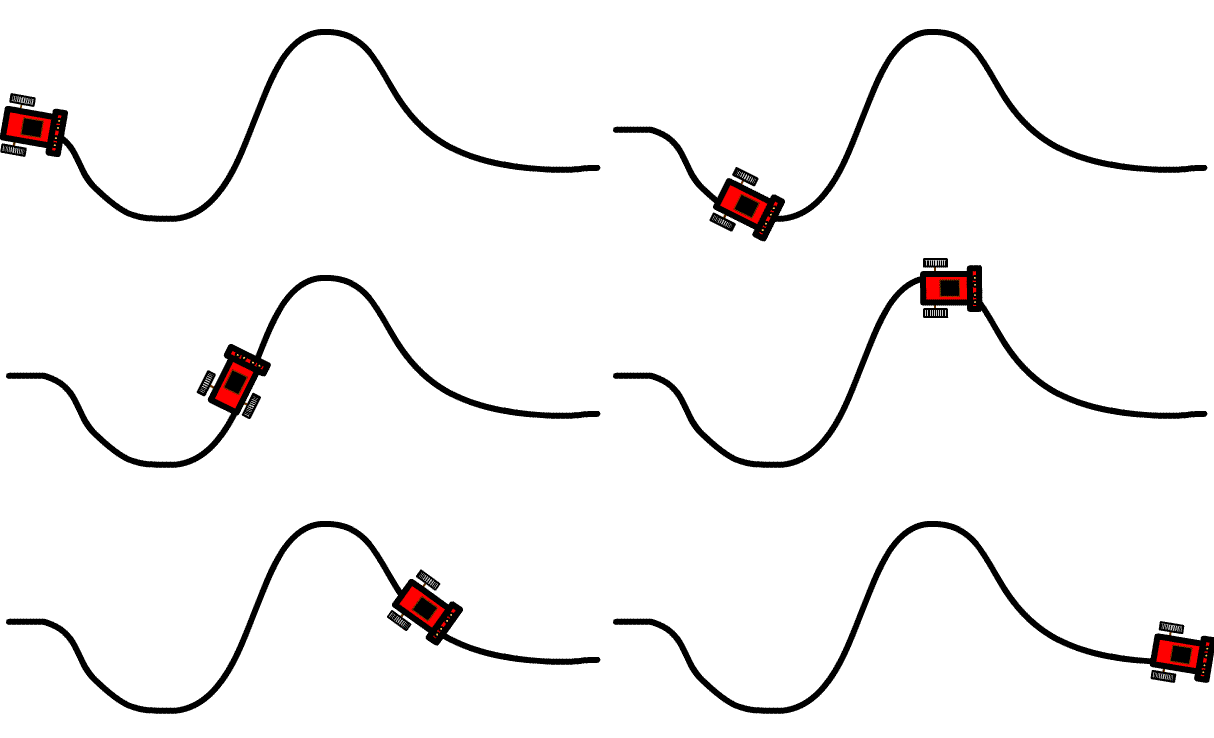
  • Understand basic line sensing and line-following behavior.
  • Build robots designed for specific tasks.
  • Compare manually controlled and autonomous robots.
  • Test and improve robot behavior.
  • Solve simple navigation and movement challenges.
  • Integrate electronics, programming, sensors, and mechanics into one robotic system.

Level 2 Junior STARtec

Basic  Electronics
Basic Electronics

Description:

Students take their first step into electronics by exploring electricity, electronic components, motors, switches, and simple control circuits.

Through experiments and mini-projects, students discover how individual components behave and gradually learn how multiple components can be combined to create useful circuits.

The course also introduces simple logic and decision-making using AND, OR, NOT, and combined logic circuits before students encounter programming. 

Learning Objectives

By the end of the course, students will be able to:

  • Recognize common electronic components and explain their basic purpose.
  • Understand the idea of a simple electrical circuit and current path.
  • Identify basic component polarity where required.
  • Connect LEDs, RGB LEDs, buzzers, and DC motors.
  • Use resistors appropriately with electronic components.
  • Control circuits using Push Buttons, Slider Switches, and ON/OFF Switches.
  • Understand the difference between an input and an output.
  • Control motor speed using a Potentiometer and Motor Driver.
  • Understand the basic purpose of the L293 Motor Driver.
  • Understand simple decision-making using AND, OR, and NOT logic.
  • Combine multiple logic gates to create simple control conditions.
  • Read and build simple circuit diagrams.
  • Troubleshoot basic circuits when they do not work.
  • Combine components creatively to build mini-projects.

Level 1 Junior STARtec