Electronics Engineering & PCB Design and Manufacturing
Description
Students build a strong foundation in Electrical and Electronics Engineering, progressing from fundamental DC electrical principles to the design and manufacturing of complete electronic circuits and printed circuit boards.
Students begin by understanding and calculating Voltage, Current, Resistance, Power, and Energy, then analyze Series and Parallel circuits using Ohm's Law and Kirchhoff's Laws.
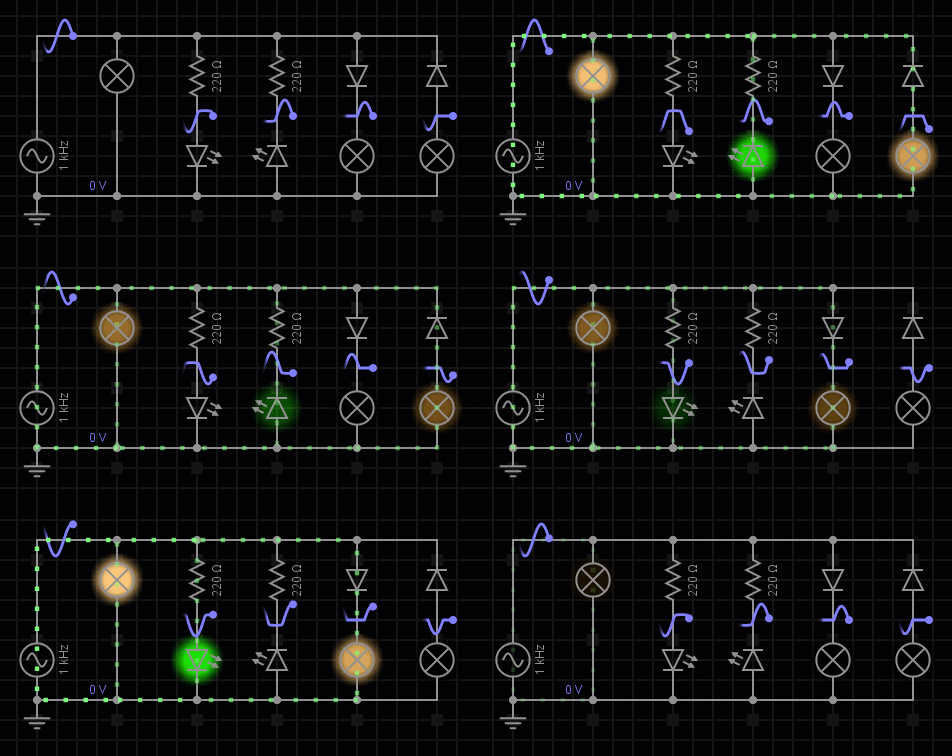
They investigate electronic components including Resistors, Capacitors, Diodes, Transistors, MOSFETs, Voltage Regulators, and Operational Amplifiers, learning not only how each component works but also how engineers select and calculate appropriate component values.
Students then progress to practical engineering circuits including Power Supplies, Voltage Regulation, Filtering, Protection, Switching, Motor Driving, Signal Conditioning, and Amplification.
Finally, students transform their circuits into professional Single-Layer and Double-Layer PCBs, learning schematic design, PCB layout, routing, grounding, manufacturing files, soldering, testing, and PCB fabrication using processes including CNC PCB Manufacturing.
By the end of the course, students move from assembling circuits to designing, calculating, manufacturing, testing, and troubleshooting their own electronic systems.
Learning Objectives
By the end of the course, students will be able to:
- Understand Voltage, Current, Resistance, Power, and Energy in DC electrical systems.
- Apply Ohm's Law to analyze and design electrical circuits.
- Analyze Series and Parallel circuits.
- Apply Kirchhoff's Voltage Law and Kirchhoff's Current Law.
- Calculate voltage, current, resistance, and power requirements.
- Select appropriate component values and power ratings.
- Use a Digital Multimeter to measure Voltage, Current, Resistance, and Continuity.
- Understand the behavior and applications of Resistors and Capacitors.
- Understand RC charging, discharging, filtering, and timing.
- Understand semiconductor fundamentals.
- Use Diodes, LEDs, Zener Diodes, and Rectifier Diodes correctly.
- Understand BJT Transistors and MOSFETs.
- Design transistor-based switching and load-driving circuits.
- Understand basic amplification.
- Design basic DC Power Supply and Voltage Regulation circuits.
- Understand Linear Regulators, LDOs, Buck and Boost Converter concepts.
- Design basic electronic Protection Circuits.
- Understand the fundamentals of Operational Amplifiers.
- Build Comparator, Buffer, Amplifier, and Signal Conditioning circuits.
- Read and create electronic schematics.
- Analyze electronic systems as functional circuit blocks.
- Prototype circuits and verify their operation using measurements.
- Troubleshoot common electronic circuit problems.
- Design Single-Layer PCBs.
- Design Double-Layer PCBs using Vias and Copper Planes.
- Understand PCB design rules, track widths, clearances, grounding, and component placement.
- Generate Gerber, Drill, and manufacturing files.
- Understand PCB manufacturing workflows.
- Manufacture PCBs using CNC PCB manufacturing equipment.
- Assemble and solder Through-Hole and SMD components.
- Test manufactured PCBs before and after power-up.
- Complete an electronic product from Requirements → Calculations → Circuit → PCB → Manufacturing → Testing.