تخطي للذهاب إلى المحتوى

كافة الدورات

C++ Fundamentals
C++ Fundamentals

Introductory Programming Courses

This course is designed to introduce students to the basics of programming using C++. It is aimed at beginners with little to no programming experience, providing a solid foundation in C++ syntax, semantics, and programming techniques. By the end of the course, students will be able to write simple to moderately complex programs in C++.  

ExpoTec Level 1 Programming
Data Structure Programming

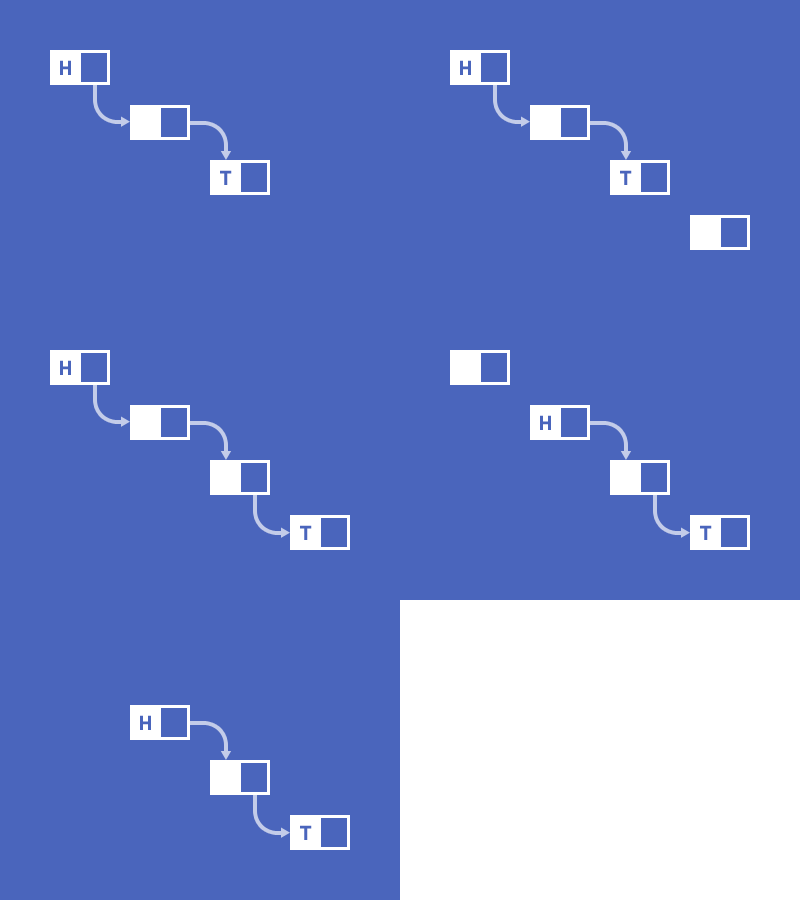
Data structure programming focuses on organizing and managing data efficiently using structures like arrays, lists, stacks, queues, and graphs. It helps optimize algorithms for tasks like searching, sorting, and mapping, forming the foundation for solving complex problems in computer science and software development.

ExpoTec Level 3 Programming
Design programming & Algorithm

Intermediate Programming Courses

Design programming and algorithms focus on creating efficient solutions to problems. It involves structuring code and selecting the best algorithms to achieve optimal performance. Algorithms are step-by-step procedures used to process data, solve problems, or perform computations, while good design ensures clarity, efficiency, and scalability in the program's structure. Together, they form the foundation for building reliable, efficient software solutions.

Level 3 ExpoTec TopX Programming
Object Oriented Programming

Intermediate Programming Courses

This course provides an in-depth exploration of Object-Oriented Programming (OOP) principles and practices using C++ and other object-oriented languages. It is designed for students with basic programming knowledge who want to deepen their understanding of OOP concepts and apply them to real-world problems.  

ExpoTec Level 2 Programming
C++ For Beginners
C++ For Beginners

Introductory Programming Courses

This course is designed to introduce students to the basics of programming using C++. It is aimed at beginners with little to no programming experience, providing a solid foundation in C++ syntax, semantics, and programming techniques. By the end of the course, students will be able to write simple to moderately complex programs in C++.  

Level 1 ExpoTec Programming
Arduino and  C++ part 1
Arduino and C++ part 1

Introductory Programming Courses

This course is designed to introduce students to the basics of programming using C++. It is aimed at beginners with little to no programming experience, providing a solid foundation in C++ syntax, semantics, and programming techniques. By the end of the course, students will be able to write simple to moderately complex programs in C++.  

Level 1 ExpoTec Programming
Arduino and  C++ part 2
Arduino and C++ part 2

Introductory Programming Courses

 This course aims to advance practical knowledge of programming and Arduino systems, focusing on communication protocols, navigation and positioning systems, and wireless technologies. It also covers the use of Inertial Measurement Units (IMU) and their practical application through projects that simulate modern intelligent systems. 

Level 1 ExpoTec Programming
Arduino & Blocks coding

Description

Students begin their StarTec journey by exploring the foundations of programming, electronics, and computational thinking using Arduino and TinkerCAD Blocks Coding.

They learn how electronic systems receive information through inputs, process that information using programmed logic, and control outputs to produce a physical response.

Starting with LEDs, Push Buttons, Slider Switches, and Potentiometers, students gradually explore Digital and Analog concepts while developing essential programming skills such as Variables, Conditions, Logical and Arithmetic Operations, Functions, Flowcharts, and Serial Communication.

Rather than learning coding as an isolated subject, students immediately use their programs to control real electronic systems and make them respond intelligently to different inputs.

Learning Objectives

By the end of the course, students will be able to:

  • Understand the basic architecture of Input → Processing → Output systems.
  • Distinguish between Digital and Analog signals.
  • Configure and control Digital Inputs and Outputs using Arduino.
  • Read Push Buttons and Slider Switches.
  • Read variable Analog values using a Potentiometer.
  • Control LED brightness using PWM.
  • Use Variables to store and manipulate information.
  • Apply Arithmetic Operations within programs.
  • Use if conditions to create decision-making systems.
  • Combine multiple conditions using Logical Operations.
  • Design simple Flowcharts before building a program.
  • Create and use Functions to organize programs.
  • Send information through Serial Communication.
  • Receive simple commands through Serial Communication.
  • Combine multiple Inputs and Outputs within one system.
  • Test, troubleshoot, and improve simple Arduino programs.
  • Translate a simple real-world problem into programmable logic.
  • Build a strong foundation in Programming Logic and Electronic Control.
Level 1 StarTec Programming
Electronics & Arduino interfacing

Introductory Programming Courses

This course is designed to introduce students to the basics of programming using C++. It is aimed at beginners with little to no programming experience, providing a solid foundation in C++ syntax, semantics, and programming techniques. By the end of the course, students will be able to write simple to moderately complex programs in C++.  

Level 2 StarTec Programming